Chicago, IL
Available 24/7 - Please Call for an Appointment
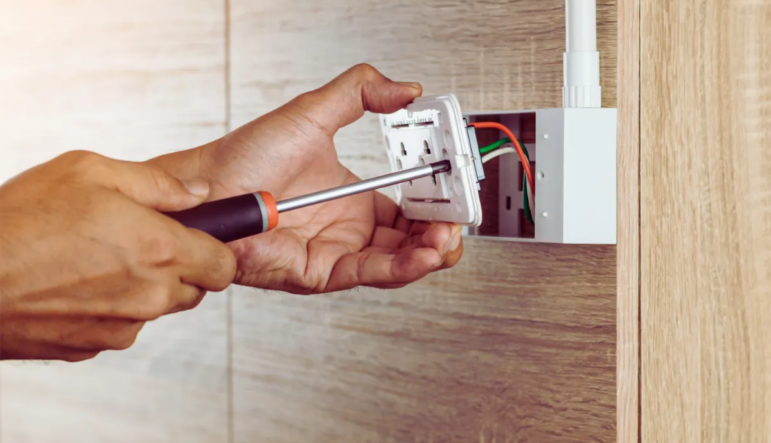
You press the reset button, the outlet comes back to life, and ten minutes later it clicks off again. Or the GFCI in the bathroom trips every morning when the hair dryer goes on, or the outdoor outlet dies every time it rains. A GFCI that keeps tripping is annoying, but it’s also the one outlet in your house that’s specifically designed to tell you something is wrong.
This guide covers what a GFCI is actually reacting to, a quick way to narrow down the cause yourself, the seven most common reasons GFCIs trip, what to do when one won’t reset at all, and when it’s time to have an electrician take a look.
A GFCI trips when it detects current leaking somewhere it shouldn’t, usually from a faulty appliance, moisture in an outdoor or basement outlet, or a wiring problem downstream. If it trips with nothing plugged in, the problem is in the wiring, the box, or the GFCI itself, and that’s a job for an electrician.
A GFCI (ground fault circuit interrupter) constantly compares the current going out on the hot wire with the current coming back on the neutral. In a healthy circuit those two numbers match. If some of that current is escaping, whether through water, damaged insulation, or a person, the numbers stop matching and the GFCI cuts power in a fraction of a second.
The trip point is tiny. Under the UL standard for the GFCIs used in homes (Class A), a GFCI must trip when the leakage reaches 6 milliamps and must not trip below 4 milliamps. For comparison, a standard 15-amp breaker allows thousands of times more current before it reacts. That sensitivity is the whole point: it’s what makes a GFCI capable of preventing a fatal shock. It also means small problems that a regular outlet would never notice will trip a GFCI.
One thing a GFCI outlet does not do is protect against overloads. Plugging a space heater and a hair dryer into the same circuit can trip the breaker in your panel, but it won’t trip a GFCI receptacle unless one of those appliances is also leaking current. If you’re not sure which one is tripping, the next section helps sort that out.
Before you assume the GFCI is bad, spend five minutes narrowing it down. If you see scorch marks, smell burning, or the outlet is wet, skip this and turn off the breaker for that circuit first.
This is the most common cause. Hair dryers, curling irons, toasters, kettles, power tools, holiday lights and old extension cords all develop small amounts of leakage as their insulation and heating elements age. Anything that’s been dropped, gotten wet, or has a frayed cord is a prime suspect. If one device trips every GFCI you plug it into, retire or repair the device. The GFCI is doing its job.
Outdoor, garage, crawl space and unfinished basement outlets trip far more than indoor ones, and moisture is usually why. Rain driven into an outlet without a proper cover, condensation inside a box on a cold exterior wall, or a slow leak above a basement outlet can all create a leakage path. If the GFCI trips during or after rain and then resets once things dry out, moisture is almost certainly involved.
Outdoor outlets should have a weather-resistant receptacle and an “in-use” bubble cover that stays closed with a cord plugged in. A flat flip cover isn’t enough for an outlet that gets rained on. A box that keeps getting wet may need to be resealed or relocated.
Appliances with large motors and compressors, especially older ones, can leak enough current to trip a GFCI, and some trip it on startup. This is a common complaint with garage refrigerators, basement chest freezers and sump pumps.
This one needs care. A GFCI that trips overnight can mean spoiled food in a freezer or, worse, a sump pump that stops running during a storm. Don’t solve it by plugging the appliance into an extension cord from a non-GFCI outlet. Have an electrician test the appliance for leakage and look at the circuit. Sometimes the appliance is failing; sometimes the fix is a dedicated circuit laid out to code; and for a sump pump, a battery backup or high-water alarm is worth considering either way.
A single GFCI near the start of a circuit can protect every outlet after it, and every one of those outlets, cords and connected devices adds a little normal leakage. Long wire runs to a garage or backyard add more. Individually it’s harmless, but added together it can push the GFCI close to its trip point, so it trips seemingly at random. The fix is usually to split the protection, with GFCIs at more locations or protection moved closer to the outlets that need it, rather than replacing the GFCI with the same setup.
If the GFCI trips with nothing plugged in, look past the GFCI itself. Common culprits are a nicked wire touching the side of a metal box, a neutral wire touching ground somewhere in a downstream outlet or fixture, water damage in a box, or a neutral shared between two circuits (common in older homes and basement remodels). Rodent damage in attics and crawl spaces also shows up this way. These faults are often invisible until someone opens each box on the circuit, which is why they’re a job for an electrician rather than guesswork.
Every GFCI has LINE terminals (power coming in) and LOAD terminals (power going on to downstream outlets). If the wires are swapped, the GFCI may refuse to reset, trip immediately, or work at the outlet itself while leaving the downstream outlets unprotected. If your tripping started right after a new GFCI went in, a DIY swap or a handyman job, miswiring is the first thing to check. Some homeowners also wire a GFCI into a two-prong circuit without understanding the labeling that comes with it; our guide to the open ground outlet explains why ungrounded circuits are a special case.
GFCIs are electronic devices, and they don’t last forever. Heat, power surges and age wear out the internal sensing circuit, and a failing unit can become oversensitive and trip for no reason, or stop protecting you at all. GFCIs made since mid-2015 include a self-test feature and are designed to cut power when they detect they’ve reached the end of their life. If a GFCI is old, trips with nothing on the circuit and no wiring fault can be found, replacing it is the fix. We cover the broader warning signs in Do Electrical Outlets Go Bad?
A GFCI that won’t reset is a different problem from one that keeps tripping, and the cause is usually one of these:
Don’t hold the RESET button in, force it, or tape it. If it won’t reset with the breaker on and nothing plugged in, the GFCI or the wiring behind it needs attention.
Here’s a situation that catches a lot of homeowners: half the outlets in the bathroom (or garage, or basement) stop working. Very often nothing is broken: a GFCI somewhere else has tripped, and the dead outlets are downstream of it. In many homes a single GFCI in one bathroom protects outlets in another bathroom, a GFCI in the garage protects the outdoor outlets, or a GFCI in the basement protects outlets you’d never connect to it.
Check every GFCI in the bathrooms, kitchen, garage, basement, laundry area and on the outside walls, and press RESET on each one. Older homes sometimes have a GFCI breaker in the panel instead, with a TEST button on the breaker itself. If you find the GFCI and it trips again as soon as you reset it, work through the steps above.
They’re easy to confuse, especially when the panel has GFCI breakers. A GFCI receptacle trips at the outlet, and the RESET button pops out. A regular breaker trips in the panel, and its handle moves to the middle or off position. A GFCI breaker trips in the panel and responds to both ground faults and overloads.
If it’s the breaker that keeps going, the cause is more likely an overload or a short than leakage, and our guide to why circuit breakers keep tripping walks through those causes. If both the GFCI and the breaker trip together, call an electrician; that combination usually means a real fault on the wiring.
The National Electrical Code has expanded GFCI requirements with almost every edition. The current national code requires GFCI protection for outlets in bathrooms, garages, outdoors, crawl spaces, basements, laundry areas, within 6 feet of a sink, and, in the newest edition, every receptacle in the kitchen, not just the countertop ones. That last change is why more homeowners are now finding their refrigerator on a GFCI.
What applies in your home depends on where you live and when the work was done. The City of Chicago enforces its own electrical code, based on an older edition of the NEC with local amendments, and many suburbs adopt different editions on their own schedules. Existing outlets generally don’t have to be upgraded just because the code changed, but when an outlet in a location that now requires GFCI protection is replaced, the replacement has to be GFCI-protected. A local electrician will know what’s required for your address and can pull the permit when one’s needed.
Call a licensed electrician if any of these apply:
If there’s heat, smoke or a burning smell, don’t wait for a convenient appointment. Turn off the breaker for that circuit and call our emergency electrician team.
When we come out for a GFCI that keeps tripping, we’re not just swapping the outlet and hoping. We start by mapping which outlets are on the GFCI and confirming it’s wired line and load correctly. Then we isolate the downstream outlets and test the circuit for leakage and insulation problems, open the boxes that are most likely to be wet or damaged, and check the GFCI itself with a tester. If an appliance is the cause, we’ll tell you. If the circuit needs a dedicated line, a better outdoor cover, or GFCI protection rearranged, you’ll get the options and the price before any work starts. Learn more about our GFCI outlet installation and repair service.
If nothing is plugged into the GFCI or any of the outlets downstream of it, the leakage is in the wiring, a box, or the GFCI itself. Moisture in an outdoor or basement outlet, a damaged wire, a neutral touching ground, or a worn-out GFCI are the usual causes. Since the fault is out of sight, this is one to have an electrician trace.
Water is getting into the outlet, the box or an outdoor fixture on the same circuit. Make sure the outlet has a weather-resistant receptacle and an in-use cover that stays closed with something plugged in, and check that the box is sealed against the siding. If it still trips in wet weather, have the box and wiring inspected.
Yes. In fact, newer codes require GFCI protection for kitchen receptacles that include the refrigerator, and many garage and basement refrigerators are on GFCIs. Most modern refrigerators run fine on one. If yours keeps tripping it, the refrigerator may be leaking current, or the GFCI may be protecting too much else. Have it tested rather than moving it to an unprotected outlet.
Yes. Age, heat and power surges wear out the internal electronics. A worn GFCI may trip for no reason, refuse to reset, or stop tripping when you press TEST, which is the most dangerous failure because it looks fine. Newer self-testing models are designed to shut off power when they reach the end of their life.
GFCI manufacturers recommend pressing TEST and then RESET once a month. When you press TEST, the outlet should go dead. If it doesn’t, or if it won’t reset afterward, replace the GFCI.
A GFCI that keeps tripping is almost always telling you something real: a device that’s leaking, a box that’s getting wet, or wiring that’s damaged somewhere you can’t see. Sometimes the fix is as simple as retiring an old hair dryer. When it isn’t, Mr. Mighty Electric can find the fault and fix it the right way. Call (773) 406-7500 or book online, and we’ll take care of your GFCI outlet installation and repair anywhere in Chicago and the suburbs.

I’m Ed Morales, owner of Mr. Mighty Electric in Chicago. I’ve helped homeowners and businesses with everything from quick repairs to major electrical upgrades. My team and I take pride in being reliable, straightforward, and always putting safety first.